


Wochenendseminar am 07. & 08. Juli 2023 im Liebknecht-Haus, Braustraße 15, 04107 Leipzig
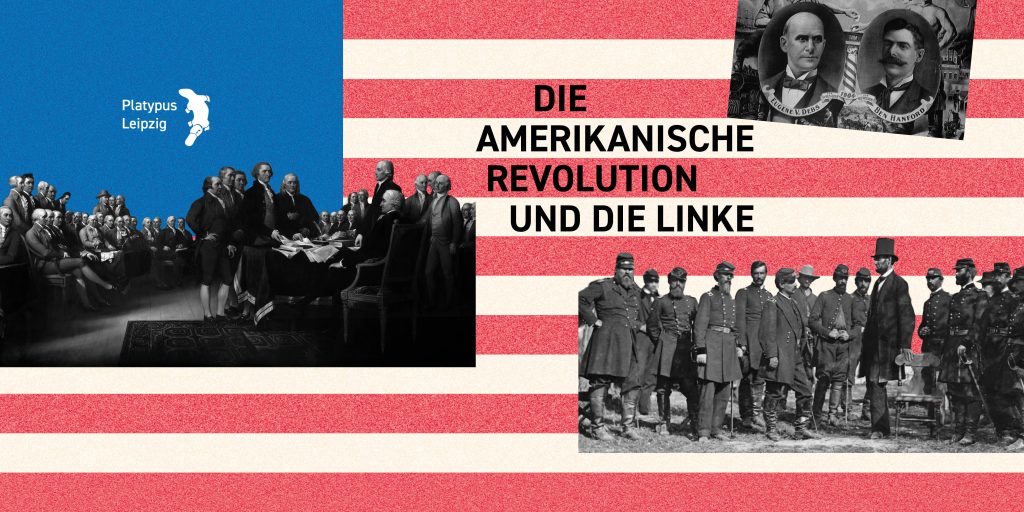
Im amerikanischen Volke lebt eine revolutionäre Tradition, die die besten Vertreter des amerikanischen Proletariats übernommen haben – jene Vertreter, die wiederholt ihre völlige Solidarität mit uns, Bolschewiki, kundgaben. Diese Tradition rührt aus dem Befreiungskriege gegen die Engländer im 18. Jahrhundert und dem Bürgerkriege im 19. Jahrhundert her. 1870 stand Amerika in gewisser Hinsicht – berücksichtigt man bloß die „Zerstörung“ einiger Zweige der Industrie und der Volkswirtschaft – weit hinter 1860 zurück. Aber wie pedantisch, ja geradezu idiotisch müsste ein Mensch genannt worden, der auf Grund dessen die höchste universell-historische, fortschrittliche und revolutionäre Bedeutung des amerikanischen Bürgerkrieges von 1863–1865 leugnen wollte.
Lenin (1918), Brief an die amerikanischen Arbeiter
Gerade während der Wahlzyklen wird die Frage nach der revolutionären Tradition der Vereinigten Staaten von allen politischen Strömungen aufgegriffen. Der rote Faden, der sich durch das Wochenendseminar zieht – bestehend aus drei aufeinander aufbauenden Blöcken: 1776, Amerikanischer Bürgerkrieg und Sozialismus in Amerika – ist das Fortbestehen und Erbe der Revolution. Wir stellen uns die Frage: Inwiefern bleibt Amerika eine revolutionäre Gesellschaft? Wie hat jedes Kapitel der amerikanischen Geschichte seit dem Beginn der Revolution im Jahr 1776 einen neuen Impuls gegeben? Dazu betrachten wir die Amerikanische Revolution aus der Perspektive der weltgeschichtlichen bürgerlichen Revolution und ihrer Krise namens Kapitalismus. Wir wollen uns die Bedeutung der revolutionären Geschichte Amerikas für Marx, die Entstehung der Ersten Internationalen und die Gründung der Zweiten Internationalen erarbeiten. Die drei Themenblöcke bauen aufeinander auf.
Das Seminar basiert im Wesentlichen auf einer von Platypus organisierten Vortragsreihe aus dem Jahr 2020. Es wird dringend empfohlen, diese im Voraus anzusehen. Die Leseliste besteht aus 'vorausgesetzten' und 'optionalen' Texten. Die vorausgesetzten Texte werden im Vorfeld von allen Teilnehmenden gelesen und bilden die Grundlage für die Diskussion in der Sitzung. Es sind keine Vorkenntnisse notwendig. Alle Interessierten sind herzlich eingeladen!
Empfohlene Vorträge zur Vorbereitung:
- American Revolution Platypus Lecture series: 1. (English) Colonial America - The Legacy of the American Revolution (6/12/20)
- American Revolution Platypus Lecture series: 2. The American Revolution - The Legacy of the American Revolution (6/19/20)
- American Revolution Platypus Lecture series: 3. The Jeffersonian Revolution - The Legacy of the American Revolution (6/26/20)
- American Revolution Platypus Lecture series: 4. Jacksonian Democracy - The Legacy of the American Revolution (7/3/20)
- American Revolution Platypus Lecture series: 5. The Civil War and Failed Reconstruction - The Legacy of the American Revolution (7/10/20)
- American Revolution Platypus Lecture series: 6. The Gilded Age - The Legacy of the American Revolution (7/17/20)
- American Revolution Platypus Lecture series: 7. American Communists & the Legacy of the Revolution - The Legacy of the American Rev. (7/24/20)
- American Revolution Platypus Lecture series: 8. The Fate of the American Revolution (7/31/20)
Block I – Die Amerikanische Revolution – 1776
Freitag, 7. Juli 16-19 Uhr, Liebknecht-Haus, Braustraße 15, Leipzig
vorausgesetzte Texte:
- Benjamin Constant Von der Freiheit des Altertums, verglichen mit der Freiheit der Gegenwart (1819)
- English Bill of Rights (1689)
- James Vaughn 1776 in world history: The American Revolution as bourgeois revolution (2014)
- Engels Minutes of Engels’s Lecture to the London German Workers’ Educational Society on November 30,1847
- Thomas Jefferson “original Rough draught" of the Declaration of Independence (1776)
- Thomas Jefferson some quotations selected by Chris Cutrone
- Thomas Jefferson to Henri Gregoire, February 25, 1809, from The Works of Thomas Jefferson in Twelve Volumes. Federal Edition. Collected and Edited by Paul Leicester.
- Thomas Jefferson to John Holmes 4/22/1820, in The American Debate over Slavery, 1760–1865: An Anthology of Sources, ed. Scott J. Hammond, Kevin R. Hardwick, and Howard Lubert (Indianapolis: Hackett Publishing, 2016), 101–102.
- Thomas Paine Excerpts Common Sense (1776)
- Richard Price Excerpts: Observations on the Importance of the American Revolution and the Means of Making It a Benefit to the World (1784)
optionale Texte:
- Excerpts from John Locke, Second Treatise on Government (1690)
- Excerpts from Jean-Jacques Rousseau, The Social Contract (1762)
- Excerpts from Adam Smith, The Wealth of Nations (1776)
- Thomas Paine, Common Sense (1776) [full text]
- “Natural and Inalienable Right to Freedom”: Slaves’ Petition for Freedom to the Massachusetts Legislature, 17 January 1777, Collections of the Massachusetts Historical Society, 5th Series, III (Boston, 1877), pp. 436–37.
- Sh*t Platypus Says (SPS) Episode 26 on 1776 (June 29, 2020)
- Teach-in James Vaughn The American Revolution and the Left (02/20/23)
- James Vaughn, History of Humanity, 1600-1763 (2012)
- James Vaughn, The History of Humanity, Pre-1750 (2012)
- Film, Jefferson in Paris (1995)
- Film, Sally Hemings: An American Scandal (2000)
Block II – Der Amerikanische Bürgerkrieg
Samstag, 8. Juli 10-13 Uhr, Liebknecht-Haus, Braustraße 15, Leipzig
vorausgesetzte Texte:
- Frederick Douglass, “What to the Slave Is the Fourth of July?” (1852)
- Lincoln, Letter on “all honour on Jefferson” (1859)
- Frederick Douglass, The Constitution of the United States: Is it Pro-Slavery or Anti-Slavery? (1860)
- Lincoln, Cooper Union Address (1860)
- Lincoln, Address at Independence Hall (1861)
- Karl Marx on the US Civil War, selections from Marx and Engels on Imperialism, ed. with intro by Spencer A. Leonard
- Marx Die Amerikanische Frage in England (1861)
- Marx Die Londoner “Times” und Lord Palmerston (1861)
- Marx Die Londoner “Times” über die Prinzen von Orléans in Amerika (1861)
- Marx Der Bürgerkrieg in den vereinigten Staaten (1861)
- Marx Ein Londoner Arbeitermeeting (1862)
- Marx Ein Vertrag gegen den Sklavenhandel (1862)
- Marx Zur Kritik der Dinge in Amerika (1862)
- Marx Zu den Ereignissen in Nordamerika (1862)
- Lincoln, Letter to Horace Greeley (1862)
- Lincoln, Gettysburg Address (1863)
- Marx, First International Address on Reelection of Abraham Lincoln (1864)
optionale Texte:
- Alexander H. Stephens (Confederate Vice President) Cornerstone Speech (1861)
- Marx Der nordamerikanische Bürgerkrieg (1861)
- Lincoln Address to Congress (1862)
- Karl Korsch Der Marxismus der Ersten Internationale (1924)
- Spencer Leonard, For liberty and union: An interview with James McPherson in The Platypus Review 53, February 2013.
- Spencer Leonard, Marx and Engels on Imperialism: Selected Journalism 1851-62 (2021)
- open yale course (Lecture 1-27) by David Blight; The Civil War and Reconstruction Era, 1845-1877
- Film, Glory (1989)
- Film, Lincoln (2012)
! Mittagspause von 13-15 Uhr !
Block III – Sozialismus in Amerika
Samstag, 8. Juli 15-18 Uhr, Liebknecht-Haus, Braustraße 15, Leipzig
vorausgesetzte Texte:
- Chris Cutrone, The end of the Gilded Age: Discontents of the Second Industrial Revolution today (2017) und Gilded Age socialism — historically past? (2023)
- Eugene Debs, “Competition vs. Cooperation” (1900)
- Debs, “The Mission of Socialism” (1901)
- Debs, “How I Became a Socialist” (1902)
- Debs, “Socialist Ideals” (1908)
- Panel: Second International Marxism in America: Origins and Crisis (2023)
optionale Texte:
- Ed Remus, Debsian Socialism in the Rearview Mirror (2023)
- Film, Oliver Stone’s Untold History of the United States: Prequel Episode A: 1900-20
- Film, The Roosevelts: An Intimate History: Episodes 1-3: Get Action, In the Arena, The Fire of Life
- Chris Cutrone, “The American Revolution and the Left” (2020)
“Society is a reality sui generis; it has its own characteristics that are either not found in the rest of the universe or are not found there in the same form."
"Society is a sui generis being with its own special nature, distinct from that of its members, and a personality of its own different from individual personalities."
-- Emile Durkheim
"Society is a concept of the Third Estate."
-- Adorno
Wednesdays
7.30 pm
Laidak, Boddinstr. 42, Neukölln
( • required / + recommended readings)
Required background reading:
• Chris Cutrone, "Back to Herbert Spencer! Industrial vs. militant society" (2016) [audio]
Recommended supplemental parallel reading:
+ Adorno, "Static and Dynamic as Sociological Categories" (1961)
+ Adorno, Introduction to Sociology 1962 lectures
+ Adorno, Philosophical Elements of a Theory of Society 1964 lectures
+ Adorno, Philosophy and Sociology 1960 lectures
Preliminary readings:
• Adorno, “Society” (1965)
• Benjamin Constant, "The liberty of the ancients compared with that of the moderns" (1819)
Charts of terms:
+ Capital in history timeline and chart of terms
+ Being and becoming (freedom in transformation) / immanent dialectical critique chart of terms
+ Capitalist contradiction chart of terms
+ Commodity form chart of terms
+ Reification chart of terms
Week 1: June 21, 2022
• Adorno, “Society” (1965)
+ Chris Cutrone, "Gillian Rose's 'Hegelian' critique of Marxism" (2010)
• Gillian Rose, Hegel Contra Sociology (1981/95) selections: Preface for 1995 reprint, 1. The Antinomies of Sociological Reason, 7. With What Must the Science End?
Week 2: June 28, 2022
• epigraphs on modern history and freedom by Louis Menand (on Marx and Engels), Karl Marx, on "becoming" (from the Grundrisse, 1857–58)
• Max Weber, The Protestant Ethic and the Spirit of Capitalism (1905) selections: Author's Introduction, Part I Chapters 1-3, Part II (+ Chapter 4,) Chapter 5
Week 3: July 5, 2022
• Auguste Comte, Introduction to Positive Philosophy (1830-42) I. The nature and importance of the positive philosophy; The Positive Philosophy of Auguste Comte vol. III Bk. VI. Social Physics pp. 1-11, 199-216, 277-344 [PDF Positive Philosophy of Comte selections]; A General View of Positivism Ch. II. The Social Aspect of Positivism pp. 63-78, Ch. VI. The Religion of Humanity pp. 340-426 [PDF General View of Positivism selections]
+ Chris Cutrone, "Ends of philosophy" (2018)
Week 4: June 12, 2022
+ Chris Cutrone, "Back to Herbert Spencer! Industrial vs. militant society" (2016) [audio]
• Herbert Spencer, Principles of Sociology Vol. I Part I The Data of Sociology Ch. I-IV pp. 3-40 [PDF] and Part II The Inductions of Sociology Ch. I-II pp. 447-462 [PDF]; On Social Evolution (Univ. Chicago selections): IV 15–16 Societal Typologies, Militancy and Industrialism and V 18–19 Ceremonial and Political Institutions; The Man Versus the State VI The Great Political Superstition [PDF selection]
Week 5: July 19, 2022
• Emile Durkheim, Chapter 3. "The principles of 1789 and sociology" (1890); Elementary Forms of Religious Life (1912) Introduction, selections V Social Creativity Ch. 11-12, in On Morality and Society
Week 6: July 26, 2022
• Durkheim, Chapter 10. "The dualism of human nature and its social conditions" (1914), Ch. 4. "Individualism and the intellectuals" (1898); The Division of Labor in Society (1893) Author's Preface to the 1st Edition and Introduction (pp. xxv-xxx and 1-10), selection IV The Evolution of Morality Ch. 6, in On Morality and Society
Week 7: August 2, 2022
• Durkheim, The Division of Labor in Society (1893) selections IV. The Evolution of Morality Chapters 7-9, in On Morality and Society; Author's Preface to the 2nd Edition (pp. xxxi-lix)
Week 8: August 9, 2022
• Frankfurt School, Aspects of Sociology (1956) selections: Preface by Horkheimer and Adorno, Chapters I-VI, XII
• Adorno, “Society” (1965)
+ Adorno, "Static and Dynamic as Sociological Categories" (1961)
Einige der größten Proteste des letzten Jahrzehnts hatten präfigurativen Charakter. Darunter Occupy und die Indignados-Bewegung (2011), die französischen zones à défendre (ZAD, 2011–18), die Gezi-Park-Proteste in Istanbul (2013), die Regenschirm-Bewegung in Hongkong (2014), die französische Versammlungsbewegung Nuit debout (2016), die Dakota Access Pipeline-Proteste in Standing Rock (2016) und die Capitol Hill Autonomous Zone in Seattle (2020). Hinzu kommen die von Gruppen wie Extinction Rebellion und Ende Gelände organisierten Klimacamps. Die meisten dieser Proteste nahmen die Form einer Besetzung an und errichteten semi-permanente Protestcamps. Diese Camps dienten einem praktischen Zweck – sie ermöglichten es den Protestierenden, ihren Protest aufrechtzuerhalten –, aber sie dienten auch als Modell für eine alternative Gemeinschaft mit ihren eigenen Codes und Werten.
Karl Wimmler, Jahrgang 1953, aufgewachsen in Liezen (Steiermark), studierte Germanistik und Geschichte und war in den 1970er-Jahren in linken Organisationen tätig. Er lebt in Graz als freier Autor und Mitarbeiter von CLIO (Verein für Geschichts- und Bildungsarbeit). Das Interview wurde von Platypus-Mitglied Andreas Wintersperger am 12.11.2022 geführt. Es folgt eine gekürzte und editierte Version des Gesprächs.
Durch die Lektüre von bedeutenden Texten der Hochphase des Marxismus in der 2. Internationalen und ihrer Krise im 20. Jahrhundert betrachten wir das Problem des Bewusstseins dieser Geschichte und ihrer politischen Implikationen für die Gegenwart. Die Textauswahl beinhaltet Schriften von Luxemburg, Lenin und Trotzki, die philosophische Reflexion des Marxismus von Lukács und Korsch und ihre Auswirkungen auf die Kritische Theorie von Benjamin, Horkheimer und Adorno.