


The V. European Conference of the Platypus Affiliated Society took place from September 8-10, 2022 at the University of Vienna, Austria. You can find the video and audio recordings of all the events below.
Thursday, September 8th
Panel Discussion: Was ist das Kritische an der Kritik der politischen Ökonomie? [German]
Was ist bürgerliche politische Ökonomie und warum entwickelt Marx eine Kritik an ihr? Wie verhält sich diese Kritik an der politischen Ökonomie zu seiner Kritik des Sozialismus? Was ist das spezifisch Politische daran? Inwiefern ist seine Kritik an der politischen Ökonomie dialektisch? Inwiefern lässt sich durch eine Rückkehr zu Marxens Kritik der politischen Ökonomie der Kampf um den Sozialismus heute re-aktualisieren?
5–7 pm (Hörsaal I at Neues Institutsgebäude, Universitätsstraße 7, 1010 Vienna)
Speakers:
- Lars Quadfasel (Hamburger Studienbibliothek)
- Representative Der Funke/International Marxist Tendency
- Frieder Otto Wolf (Philosopher and Political Scientist)
Friday, September 9th
Teach-In: What is Society?
After the fall of the Berlin Wall, both Thatcher and Laclau could agree on one thing: “society” does not exist. Since 2015, a meme circulates stating vapidly: “We live in a society.” What was society? What is its crisis? Two 19th century phenomena, “socialism” and “sociology”, continue to haunt us. Can we make sense of them without a concept of “society”?
10–12 am (Hörsaal I at Neues Institutsgebäude, Universitätsstraße 7, 1010 Vienna)
Presentations by different leftists organizations
Different leftist organizations get the opportunity to present themselves, their aims, and their activities.
1.30–4 pm (Hörsaal 6, 2 and 3 at Oskar-Morgenstern-Platz 1, 1090 Vienna)
1.30–2.30 pm
Malmoe
MALMOE is a device for everyday life. Based in Vienna since 2000 the collective prints a newspaper 4 times a year to create a leftist space for discourse and pop-culture. In the workshop we will focus on practical challenges in production and community building.
https://www.malmoe.org/
Hörsaal 6
3–4 pm
Junge Linke (Young Left)
Junge Linke is Austria’s biggest communist youth organisation. Founded in 2018, Junge Linke offers room for education and discussion on the one hand and the opportunity of coordinated political action on the other. Today Junge Linke is closely cooperating with the Austrian Communist Party (KPÖ) in attempting to rebuild a strong and unified Left.
https://www.jungelinke.at/
Hörsaal 2
transform! europe
transform! europe is a network of 39 European organisations from 23 countries, active in the field of political education and critical scientific analysis, and is the recognised political foundation corresponding to the Party of the European Left (EL). The Workshop will focus on a presentation given by member of transform Dunja Larise on the following topic: 'Why is Austromarxism still worth studying in the 21st century?'
https://www.transform-network.net/about-us/
Hörsaal 3
Panel Discussion: The Dictatorship of the Proletariat and the Left
What was the Marxist understanding of the Dictatorship of the Proletariat? How has our understanding of the necessity of the dictatorship of the proletariat been shaped and changed over the course of the 20th century? What is its relevance for the struggle for socialism today?
5–7 pm (Hörsaal I at Neues Institutsgebäude, Universitätsstraße 7, 1010 Vienna)
Speakers:
- Thodoris Velissaris (Platypus Affiliated Society)
- David Harvie (Political Economist)
- Gavin Mendel-Gleason (Workers' Party of Ireland)
- Olga Stefou (SYRIZA)
Saturday, September 10th
Teach-In: Prefigurative Politics and the Millennial Left
Before folding into centre-Left political parties, the Millennial Left went through a ‘neo-anarchist’ or ‘prefigurative’ phase. The ‘movement of the squares’ (encompassing Occupy and the Indignados) is the most visible manifestation of this prefigurative turn in politics. With prefiguration on the rise again today, this teach-in seeks to clarify and critique this tendency as a historical phenomenon of the Left.
10–12 am (Hörsaal III at Neues Institutsgebäude, Universitätsstraße 7, 1010 Vienna)
Panel Discussion: Solidarność in the 1980s and the politics of solidarity
Solidarność (Solidarity) emerged in Poland in 1980 as a movement for workers solidarity with self-governing shipyard unions. With the support of dissident Polish intellectuals at home and broad sections of the Left abroad, Solidarność grew in strength and became a key participant in Polish reforms through the 80s and beyond. As such, it can appear as either a late expression of New Left attempts to further the revolution, or as a prefiguration of the dissolution of the Soviet Union.
2–4 pm (Hörsaal I at Neues Institutsgebäude, Universitätsstraße 7, 1010 Vienna)
Speakers:
- Bruno Drweski (National Institute of Oriental Languages and Civilizations)
- Ákos Földesi (Szikra)
- Mateusz Wasilewski (Platypus Affiliated Society)
- Marek Beylin (Historian and Journalist)
Public Interview: What is Left of SYRIZA?
“You, SYRIZA, the true miracle, radical left movement, which stepped out of the comfortable position of marginal resistance and courageously signaled your readiness to take power. This is why you have to be punished.”
- Slavoj Zizek, 2012
In the recent past SYRIZA exemplified a moment of hope for a large part of the (European) Left. In sharp contrast, today it is considered an example of capitulation to the establishment and a scapegoat for the spoiled chances of the anti-austerity struggles. The stakes of SYRIZA politics were enigmatically expressed in the phrase: “SYRIZA was in government but not in power”. This interview wants to explore the legacy of SYRIZA and the sense in which SYRIZA did or did not express potential for radical political change. Nikos Manousakis, member of the Platypus Affiliated Society, will interview Olga Stefou, member of the SYRIZA Central Committee.
5–7 pm (Hörsaal I at Neues Institutsgebäude, Universitätsstraße 7, 1010 Vienna)
Thursdays, 6:30 - 9:00PM
1350 N Wells St, Chicago, IL 60610-1908
Find the Facebook Events for each session: https://fb.me/e/1Y4dktIPH
• required / + recommended reading
“Society is a reality sui generis; it has its own characteristics that are either not found in the rest of the universe or are not found there in the same form."
"Society is a sui generis being with its own special nature, distinct from that of its members, and a personality of its own different from individual personalities."
-- Emile Durkheim
Required background reading:
• Chris Cutrone, "Back to Herbert Spencer! Industrial vs. militant society" (2016)
Recommended supplemental parallel reading:
+ Adorno, "Static and Dynamic as Sociological Categories" (1961)
+ Adorno, Introduction to Sociology 1962 lectures
+ Adorno, Philosophical Elements of a Theory of Society 1964 lectures
+ Adorno, Philosophy and Sociology 1960 lectures
Preliminary readings:
• Adorno, “Society” (1965)
• Benjamin Constant, "The liberty of the ancients compared with that of the moderns" (1819)
Charts of terms:
+ Capital in history timeline and chart of terms
+ Being and becoming (freedom in transformation) / immanent dialectical critique chart of terms
+ Capitalist contradiction chart of terms
+ Commodity form chart of terms
+ Reification chart of terms
Week 1: June 9, 2022
• Gillian Rose, Hegel Contra Sociology (1981/95) selections: Preface for 1995 reprint, 1. The Antinomies of Sociological Reason, 7. With What Must the Science End?
Week 2: June 16, 2022
• Max Weber, The Protestant Ethic and the Spirit of Capitalism (1905) selections: Author's Introduction, Part I Chapters 1-3, Part II (+ Chapter 4,) Chapter 5
Week 3: June 23, 2022
• Auguste Comte, Introduction to Positive Philosophy (1830-42) I. The nature and importance of the positive philosophy; The Positive Philosophy of Auguste Comte vol. III Bk. VI. Social Physics pp. 1-11, 199-216, 277-344; A General View of Positivism Ch. II. The Social Aspect of Positivism pp. 63-78, Ch. VI. The Religion of Humanity pp. 340-426
Week 4: June 30, 2022
+ Chris Cutrone, "Back to Herbert Spencer! Industrial vs. militant society" (2016) [audio]
• Herbert Spencer, Principles of Sociology Vol. I Part I The Data of Sociology Ch. I-IV pp. 3-40 and Part II The Inductions of Sociology Ch. I-II pp. 447-462; On Social Evolution (Univ. Chicago selections): IV 15–16 Societal Typologies, Militancy and Industrialism and V 18–19 Ceremonial and Political Institutions; The Man Versus the State VI The Great Political Superstition
Week 5: July 7, 2022
• Emile Durkheim, Chapter 3. "The principles of 1789 and sociology" (1890); Elementary Forms of Religious Life (1912) Introduction, selections V. Social Creativity Chapters 11-12, in On Morality and Society
Week 6: July 14, 2022
• Durkheim, Chapter 10. "The dualism of human nature and its social conditions" (1914), Chapter 4. "Individualism and the intellectuals" (1898); The Division of Labor in Society (1893) Introduction (pp. 1-10), selection IV. The Evolution of Morality Chapter 6, in On Morality and Society
Week 7: July 21, 2022
• Durkheim, The Division of Labor in Society (1893) selections IV. The Evolution of Morality Chapters 7-9, in On Morality and Society; Preface to the 2nd Edition (pp. xxxi-lix)
Week 8: July 28, 2022
• Frankfurt School, Aspects of Sociology (1956) selections: Preface by Horkheimer and Adorno, Chapters I-VI, XII
• Adorno, “Society” (1965)
Donnerstag, 05. Mai 2022, 19 Uhr im Index, Breite Straße 1
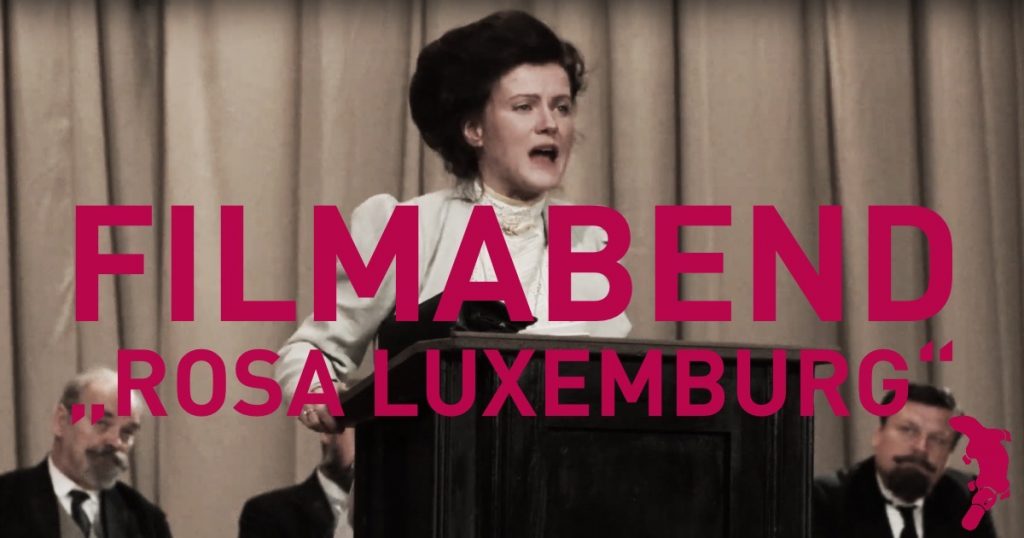
Passend zu unserem Lesekreis des Sommersemesters "Was ist revolutionärer Marxismus?" wollen wir zusammen mit euch einen Film über eine der bedeutendsten Figuren des Marxismus schauen.
"Rosa Luxemburg", erschienen 1986, von der Regisseurin Margarethe von Trotta zeichnet die Biographie der Sozialdemokratin nach und liefert ein anschauliches Panorama der damaligen gesellschaftlichen Situation.
Vor dem Film wird es einen kleinen historischen Input geben.
Kommt vorbei, der Eintritt ist kostenlos!
Ort: Index, Breite Straße 1, 04317 Leipzig
Zeit: 05.05.2022, 19 Uhr (Einlass ab 18:30 Uhr)
Die vorgeführten Filme sollen einen Rahmen schaffen für den zweiten Teil des Lesekreises der Platypus Affiliated Society, „Was ist revolutionärer Marxismus?“.
Sie beschäftigen sich mit der historischen Periode des ausgehenden 19. und beginnenden 20. Jahrhunderts, eine Zeit des Umbruchs sowohl welthistorisch wie auch in der Geschichte des Marxismus und der Linken.
Es werden die folgenden Filme gemeinsam geschaut und anschließend in einer gelassenen Atmosphäre diskutiert.
Zeit: Dienstags 20:00 Uhr, an den unten zu findenden Daten
Ort: Online via Zoom; Zoom-Meeting: https://us02web.zoom.us/j/88946790256
Die Sitzungen beinhalten immer ca. 2 Stunden Film
FILME
26.04. - Rosa Luxemburg Film.
03.05. - Fall of Eagles Episode #5 "The Last Tsar" und #6 "Absolute Beginners" über die Ursprünge der Bolschewiki.
10.05. - 37 Days Episode #3 "One Long Weekend" über den Beginn des 1.WK; und Fall of Eagles Episode #12 "The Secret War" über den ersten Weltkrieg und die Russische Revolution.
17.05. - Fall of Eagles Episode #13 "End Game" über die deutsche Revolution 1918-19; und Oliver Stones' Untold History of the United States Prequel Episode A. 1900-20, über Imperialismus, den ersten Weltkrieg und die Russische Revolution.
24.05. - Fall of Eagles Episode #7 "Dearest Nicky" und #8 "The Appointment" über den Russisch-Japanischen Krieg, die Russische Revolution 1905, über Modernisierung, Narodniki und die Sozialrevolutionäre.
07.06. - Lenin: The Train über Lenins Reise im plombierten Wagen aus der Schweiz nach Petrograd im Jahr 1917. Während der Fahrt diskutiert Lenin mit den Mitreisenden seine politischen Vorstellungen.
14.06. - Reds über die amerikanischen Anarchisten, Sozialisten und Kommunisten während des 1. WK und die russische Revolution.
05.07. - Oliver Stones' Untold History of the United States Prequel Episode B. 1920-40 über Konterrevolution, Faschismus, die Große Depression, Stalinismus und Nazismus.
19.07. - Arguing The World, ein dokumentarisches Porträt der New York Intellectuals Irving Kristol, Irving Howe, Daniel Bell und Nathan Glazer.
16.08. - Was war links? Teil 1: Protest und Theorie und Teil 2: Dutschke und Konsorten, eine Dokumentation über die Neue Linke.
23.08. - Was war links? Teil 3: Lärm und Gewalt und Teil 4: Kunst und Klassenkampf, eine Dokumentation über die Neue Linke.

Der Marxismus nach dem Tod von Marx und Engels erfährt mit dem rasanten Wachstum der Arbeiterbewegung und der Entstehung der zweiten Internationale den Charakter einer politischen Massenbewegung, die sich in alle Teile der Welt verbreitet. Wir möchten im ersten Teil des Lesekreises genauer betrachten, worin der berühmt-berüchtigte Marxismus der Arbeiterbewegung bestanden und welche Krise ihn vor dem Beginn des Ersten Weltkrieges erfasst hat. Der Kampf gegen diese “Krise des Marxismus” hat mit der Oktoberrevolution und der deutschen Arbeiterrevolution von 1918-19 einen welthistorischen Maßstab erreicht, der die Hoffnungen und Katastrophen des zwanzigsten Jahrhunderts vorbereitete. Was war das Ziel der 1917 eingeleiteten internationalen Revolution und wie ist diese gescheitert? Welche politischen und ideologischen Konsequenzen folgten daraus?
Um diese Fragen näher zu beleuchten, werden wir uns in der zweiten Hälfte des Semesters mit den Reflexionen dieser Entwicklungen beschäftigen, wie sie von zentralen Figuren der Frankfurter Schule entwickelt wurden. Mit Lukács, Benjamin, Horkheimer und Adorno werden wir die Spannung, Kontinuität und Differenz zu den Vertretern der klassischen Periode des Marxismus entwickeln und uns somit ein bedeutendes Instrumentarium zum Verständnis der gegenwärtigen Welt anzueignen suchen. Das problematische Verhältnis von Theorie und Praxis im Marxismus und seiner Entwicklung hat die Welt des zwanzigsten Jahrhunderts entscheidend geprägt und hinterlässt ihre Narben bis in die Gegenwart. Mit der Erforschung dieses Verhältnisses möchten wir Aufschluss darüber erhalten, wie die Vergangenheit unsere eigene Imagination der Zukunft in Bann hält.
Die Texte werden im Voraus gelesen und dann zusammen diskutiert. Neueinsteiger:innen sind herzlich willkommen und es werden keine Vorkenntnisse benötigt
Zeit: Donnerstags 18:00-21:00
Ort: HU Berlin, Institut für Geschichtswissenschaften, Friedrichstraße 191, Raum 4026
• vorausgesetzte Texte
+ zusätzlich, empfohlene Texte
Empfohlene Vorbereitungs- und Hintergrundliteratur
+ Edmund Wilson: „To the Finland Station: A Study in the Writing and Acting of History“ (1940), Part II. Ch. (1–4,) 5–10, 12–16; Part III. Ch. 1–6
+ Carl Schorske, The SPD 1905-17: The Development of the Great Schism (1955)
+ Leszek Kolakowski: „Der Sinn des Begriffes ‘Linke’” (1958)
+ J.P. Nettl, Rosa Luxemburg(1966) [Vol. 1] [Vol. 2]
+ James Joll: „The Second International 1889–1914“ (1966)
+ Sebastian Haffner: “Die deutsche Revolution 1918/19” (1968)
+ Richard Appignanesi and Oscar Zarate / A&Z: “Lenin für Anfänger” (1977)
+ Tariq Ali and Phil Evans: „Trotzki für Anfänger“ (1980)
Sitzungen
Woche 17. Revolutionäre Führung | 21.04.2022
• Rosa Luxemburg, „Die ‚Junius-Broschüre‘ / Krise der Sozialdemokratie“ Teil I. (1916)
• J. P. Nettl, “The German Social Democratic Party 1890–1914 as a Political Model” (1965)
• Cliff Slaughter, “What is Revolutionary Leadership?” (1960)
Woche 18. Reform oder Revolution? | 28.04.2022
• Luxemburg, „Sozialreform oder Revolution“ (1899)
+ Eugene Debs, “Competition vs. Cooperation” (1900)
Woche 19. Lenin und die Avantgardepartei | 05.05.2022
• Spartakist-Broschüre, Lenin und die Avantgardepartei (1978)
+ Richard Appignanesi and Oscar Zarate / A&Z, Introducing Lenin and the Russian Revolution / Lenin for Beginners (1977)
Woche 20. Was tun? | 12.05.2022
W. I. Lenin, „Was tun?“ (1902)
+ Richard Appignanesi and Oscar Zarate / A&Z, Introducing Lenin and the Russian Revolution / Lenin for Beginners (1977)
Woche 21. Massenstreik und Sozialdemokratie | 19.05.2022
• Luxemburg, „Massenstreik, Partei und Gewerkschaften“ (1906)
+ Luxemburg, „Blanquismus und Sozialdemokratie“ (1906)
Woche 22. Permanente Revolution | 26.05.2022
• Leo Trotzki, „Ergebnisse und Perspektiven“ (1906)
+ Tariq Ali and Phil Evans, Introducing Trotsky and Marxism / Trotsky for Beginners (1980)
Woche 23. Staat und Revolution | 02.06.2022
• Lenin, „Staat und Revolution“ (1917)
Woche 24. Imperialismus | 09.06.2022
“Es ist die Sache der Bourgeoisie, die Trusts zu fördern, Kinder und Frauen in die Fabriken zu jagen, sie dort zu martern, zu korrumpieren, unsäglichem Elend preiszugeben. Wir „unterstützen“ diese Entwicklung nicht, wir „fordern“ so etwas nicht, wir kämpfen dagegen. Aber wie kämpfen wir? Wir erklären, die Trusts und die Fabrikarbeit der Frauen sind progressiv. Wir wollen nicht zurück, zum Handwerk, zum vormonopolistischen Kapitalismus, zur Hausarbeit der Frauen. Vorwärts über die Trusts usw. hinaus und durch sie zum Sozialismus.”
– Lenin: Das Militärprogramm der proletarischen Revolution (1916)
• Lenin, „Der Imperialismus als höchstes Stadium des Kapitalismus“ (1916)
+ Lenin, „Sozialismus und Krieg“ (1915)
Woche 25. Scheitern der Revolution | 16.06.2022
• Luxemburg, „Was will der Spartakusbund?“ (1918)
• Luxemburg, „Unser Programm und die politische Situation“ (1918)
+ Luxemburg, „Die Sozialisierung der Gesellschaft“ (1918)
+ Luxemburg, „Die russische Tragödie“ (1918)
+ Luxemburg, „Die Ordnung herrscht in Berlin“ (1919)
+ Eugene Debs, “The Day of the People” (1919)
+ Sebastian Haffner: „Die deutsche Revolution 1918/19“ (1968) [engl. PDF]
Woche 26. Rückzug nach der Revolution | 23.06.2022
• Lenin, „Der „Linke Radikalismus“, die Kinderkrankheit im Kommunismus“ (1920)
+ Lenin, „Notizen eines Publizisten“ (1922/24)
Woche 27. Dialektik der Verdinglichung | 30.06.2022
• Georg Lukács, „Der Standpunkt des Proletariats“ (= Teil III. des Kapitels „Die Verdinglichung und das Bewußtsein des Proletariats“) in Geschichte und Klassenbewusstsein (1923)
+ Being and becoming (freedom in transformation) / immanent dialectical critique chart of terms
+ Commodity form chart of terms
+ Capitalist contradiction chart of terms + Organic composition of capital chart of terms
+ Reification chart of terms
+ Lukács, „Das Phänomen der Verdinglichung“ (Teil I des Kapitels „Die Verdinglichung und das Bewusstsein des Proletariats“, in Geschichte und Klassenbewusstsein (1923)
Woche 28. Lehren des Oktobers | 07.07.2022
• Trotzki, „1917 – Die Lehren des Oktobers“ (1924)
• Trotzki, „Bolschewismus und Stalinismus“ (1937)
Woche 29. Trotzkismus | 14.07.2022
+ Trotzki, “To Build Communist Parties and an International Anew” (1933)
+ Trotzki, „Wenn Amerika kommunistisch würde“ (1934)
• Trotzki, „Der Todeskampf des Kapitalismus und die Aufgaben der 4. Internationale“ (Das Übergangsprogramm) (1938)
+ Trotzki, „Die Gewerkschaften in der Epoche des imperialistischen Niedergangs“ (1940)
+ Trotzki, „Brief an James P. Cannon“ (1939)
Woche 30. Der autoritäre Staat | 21.07.2022
• Friedrich Pollock, „Staatskapitalismus“ (1941)
• Max Horkheimer, „Autoritärer Staat“ (1940/1942)
+ Capitalist contradiction chart of terms
Woche 31. Über den Begriff der Geschichte | 28.07.2022
• epigraphs by Louis Menand (on Edmund Wilson) and Peter Preuss (on Nietzsche) on the modern concept of history
+ Charles Baudelaire, from Fusées [Rockets] (1867)
+ Bertolt Brecht, „An die Nachgeborenen“ (1939)
+ Walter Benjamin, „Zum Planetarium“ (aus: Einbahnstraße, 1928)
+ Benjamin, „Feuermelder“ (aus: Einbahnstraße, 1928)
+ Benjamin, „Erfahrung und Armut“ (1933)
+ Benjamin, Theologisch-politisches Fragment (1921/39?)
+ Benjamin on history chart of terms
• Benjamin, „Über den Begriff der Geschichte“ (1940)
• Benjamin, „Paralipomena zu den Thesen Über den Begriff der Geschichte“ (1940)
+ Benjamin, Das Passagen-Werk Konvolut N, „Erkenntnistheoretisches, Theorie des Fortschritts“ (v. a. S. 588 f.)
+ Being and becoming (freedom in transformation) / immanent dialectical critique chart of terms
Woche 32. Reflexionen über den Marxismus | 04.08.2022
+ Capital in history timeline and chart of terms
+ Benjamin on history chart of terms
• Theodor Adorno, „Reflexionen zur Klassentheorie“ (1942)
• Adorno, „Ausschweifung“ (Anhang Minima Moralia) (1944–47)
+ Being and becoming (freedom in transformation) / immanent dialectical critique chart of terms
+ Adorno, „Zueignung“, „Vermächtnis“, „Vor Mißbrauch wird gewarnt“ und „Zum Ende“ aus Minima Moralia (1944-47)
+ Horkheimer and Adorno, Diskussion über Theorie und Praxis (1956)
Woche 33. Theorie und Praxis | 11.08.2022
+ Adorno, „Zu Subjekt und Objekt“ (1969)
+ Commodity form chart of terms
+ Reification chart of terms
+ Capitalist contradiction chart of terms
+ Adorno's critique of actionism chart of terms
• Adorno, „Marginalien zu Theorie und Praxis“ (1969)
• Adorno, „Resignation“ (1969)
+ Being and becoming (freedom in transformation) / immanent dialectical critique chart of terms
+ Adorno, „Spätkapitalismus oder Industriegesellschaft?“ (1968) [Audio]
+ Organic composition of capital chart of terms
+ Esther Leslie, Introduction to the 1969 Adorno-Marcuse correspondence (1999)
+ Adorno and Herbert Marcuse, „Briefwechsel über die Neue Linke“ [Dokumente Nr. 300, 313, 322, 336, 338, 340 & 349] (1969)
+ Der Spiegel, Interview mit T. W. Adorno: „Keine Angst vor dem Elfenbeinturm“ (1969)