


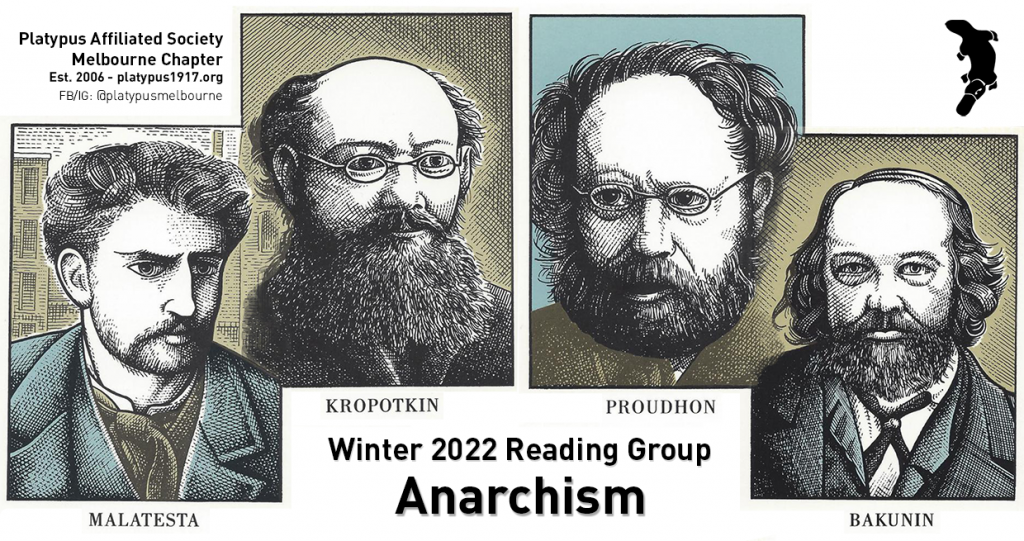
Melbourne
Thursdays 6:30–9PM AEDT
The Clyde Hotel - 385 Cardigan Street, Carlton VIC
[time and location subject to change]Contact: pas1917melbourne@gmail.com
On the web: Facebook Event
• required / + recommended readings
Recommended background readings:
+ Chris Cutrone, "On anarchism and Marxism" (2008)
+ Trevor Bark, "Half-time team talk" (response to Cutrone) (2008)
+ Cutrone, "Against dogmatic abstraction" (2010)
Week 1 | Jun. 23, 2022
• Pierre-Joseph Proudhon, What is Property? (1840)
+ Max Stirner, The Ego and Its Own (1845)
Week 2 | Jun. 30, 2022
• Mikhail Bakunin, God and the State (1871)
+ Bakunin, A Critique of the German Social-Democratic Program (1870)
+ Bakunin, Marxism, Freedom and the State (1872)
+ Ferdinand Lassalle, Open letter to the German workers’ movement (1863)
Week 3 | Jul. 7, 2022
• Peter Kropotkin, Anarchist Communism (1909)
+ Kropotkin, “The Russian Revolution and the Soviet Government” (1919)
+ Kropotkin, The Conquest of Bread, especially Chapters 3, 11 and 12 (1906)
Week 4 | Jul. 14, 2022
• Errico Malatesta, Syndicalism and Anarchism (1926)
• Malatesta and Nestor Makhno, About the Platform (1927-29)
Week 5 | Jul. 21, 2022
• Murray Bookchin, Listen, Marxist! (1969)
Additional Resources
Platypus Review
+ Herb Gamberg Anarchism through Bakunin: A Marxist Assessment (PR#64 March 2014)
+ Liam Swenson The Leninist Protests Too Much: A response to Herb Gamberg (PR#65 April 2014)
+ Wayne Price In defense of anarchism: A response to Herb Gamberg (PR#65 April 2014)
+ Herb Gamberg On Anarchism and Marxism: In response to Price and Swenson (PR#66 May 2014)
Panels
+ Christoph Lichtenberg, Alex Khasnabish, Chris Parsons, Eva Curry Radical ideologies today: Marxism and anarchism (PR#65 April 2014)
Anarchist Literature
Anarchism in Australia @ Red & Black Notes
Artwork from Clifford Harper
Platypus Frankfurt lädt zum Ferienlesekreis über "Kunst und Politik".
Ort: Zoom, Link: https://us02web.zoom.us/j/89725048788
Zeit: Immer Dienstags 18–21 Uhr
Erster Termin: 23.06.2020
Die Texte werden zu Hause gelesen und beim Lesekreis besprochen. Kein Vorwissen ist nötig. Neue Gesichter sind immer gern gesehen.
● vorausgesetzte Texte / + zusätzlich empfohlene Texte
Vorausgesetzte Lektüre:
• Chris Cutrone et al., “The relevance of Critical Theory to art today” (2011)
Woche 1. Nach der Postmoderne: Kunst und Politik? | 23. Juni 2020
• Susan Buck-Morss, Susan Buck-Morss, Response to Visual culture questionnaire (1996)
• Robert Pippin, "On Critical Theory" (2004)
+ Being and becoming (freedom in transformation) / immanent dialectical critique chart of terms
• Chris Cutrone, "The relevance of Critical Theory to art today" (2011)
• Chris Cutrone, "An incomplete project? Art and politics after postmodernism" (2010)
Woche 2. Die Bedeutung von Kunst | 30. Juni 2020
• Immanuel Kant, Vorwort und Einleitung zur Kritik der Urteilskraft (1790)
+ Being and becoming (freedom in transformation) / immanent dialectical critique chart of terms
+ Kant's 3 Critiques
and philosophy
Woche 3. Die Kunst und die Menschheit | 7. Juli 2020
• Friedrich Schiller, Briefe über die ästhetische Erziehung des Menschen (1794)
+ Schiller on aesthetic education (and Nietzsche on art) chart of terms
Woche 4. Moderne Ästhetik der Kunst | 14. Juli 2020
• G.W.F. Hegel, Vorlesungen über die Ästhetik, Erster Abschnitt:
"Einleitung" bis (inklusive) "3. Zweck der Kunst" (1835)
Woche 5. Moderne und Modernismus | 21. Juli 2020
• Heinrich Heine, Auszüge aus Der Salon 1 (1831)
• Heinrich Heine, Auszüge aus Der Salon 2 (1843)
+ Baudelaire on the modern / modernity / modernism chart of terms
• Charles Baudelaire, Auszüge aus Pariser Spleen (1867)
• Charles Baudelaire, Auszüge aus Salon 1846 (1846)
• Charles Baudelaire, Auszuüge aus die Blumen des Bösen (1857)
• Charles Baudelaire, Auszüge aus Der Maler des modernen Lebens (1863)
Woche 5.2 Die Kunst und die Revolution [I] | 21. Juli 2020
• Richard Wagner, "Die Kunst und die Revolution" (1849)
Woche 6. Kunst als Rechtfertigung des Lebens? | 28. Juli 2020
• Friedrich Nietzsche, "Die Geburt der Tragödie aus dem Geiste der Musik" (1872, inklusive des "Versuch einer Selbstkritik“ von 1886)
+ Schiller on aesthetic education (and Nietzsche on art) chart of terms
Woche 7. Kunst und Revolution [II] | 11. August 2020
• Walter Benjamin, "Über das mimetische Vermögen" (1934)
• Chris Cutrone, "Trotsky, Benjamin, Adorno and Greenberg's critique of 'revolutionary art' " (2020)
• Leon Trotzki, "Kunst und Revolution. Leserbrief an den New Yorker Partisan Review“ (1939)
• Clement Greenberg, "Avant-garde and kitsch" (1939)
Woche 8. Revolutionäre Kunst? | 18. August 2020
• Walter Benjamin, "Erfahrung und Armut" (1934)
• Walter Benjamin, "Der Autor als Produzent" (1934)
• Jürgen Habermas, "Die Moderne – ein unvollendest Projekt" (1981)
Woche 9. Kunst und Kapitalismus | 25. August 2020
• Walter Benjamin, "Das Kunstwerk im Zeitalter seiner technischen Reproduzierbarkeit" (1936)
• Theodor W. Adorno „an Walter Benjamin“, Brief vom 18. März 1936
• Siegfried Kracauer, „Die Photographie“ (1927)
• Walter Benjamin, „Kleine Geschichte der Photographie" (1931)
Woche 10. Die Notwendigkeit und Unmöglichkeit der Kunst | 01. September 2020
• Theodor W. Adorno, "Jene zwanziger Jahre" (1962)
• Theodor Adorno, Ästhetische Theorie (1970): „Selbstverständlichkeit von Kunst verloren“ (S. 9–11) und „Gesellschaft“ (S. 334–389)
• Stewart Martin, “Critique of relational aesthetics” (2007)
• Stewart Martin, “The absolute artwork meets the absolute commodity” (2007)
Alle pdf-Texte (ohne online-Quellen) in Reihenfolge