


To know the worst: Anti-Semitism and the failure of the Left on Iran
Stephan Grigat
Platypus Review 49 | September 2012
DESPITE THE CREATION OF AN AUTOCRATIC and anti-Semitic regime after the Khomeneiite revolution of 1979, the European Community and later the European Union continued to deal with the Islamic Republic of Iran; and even with new, insufficient sanctions in place, trade with Iran continues until today. It is the capitalist state’s primary task to allow the further realization of capital, but there is a certain sense in which politics surpasses this function. Government policy is indeed not indifferent when it comes to the choice of whom it trades with. Accordingly, the U.S. and Israel, who are considered forms of Satan in the eyes of the Iranian regime, have banned large-scale transactions with Iran. Capital and state do indeed follow their own logic of commercialization and domination. However, the Left, which is critical of the state and capitalism, must not be indifferent to the different results of this logic. As important as the critique of state and capital may be, it is also crucially important whether business is done with Iceland, Ireland, Italy, India, or Iran.
For Iran’s government, every success in business means progress and a further step in its jihad against emancipation and enlightenment. With the pursuit of nuclear bomb technology in mind, its agenda has to be understood as a political program of annihilation. If liberal and radical leftists want to be serious about Adorno’s imperative, formulated in his Negative Dialectics—that in the state of humanity’s unfreedom, thought and action must be arranged in a way so that Auschwitz may never repeat itself—then they should do everything to prevent the Iranian regime from realizing its murderous ideology and facilitate its overthrow. It seems apposite, and it is not by coincidence that, as the motto for the second part of his collection of aphorisms, Minima Moralia, Adorno quoted F. H. Bradley, “Where everything is bad, it’s good to know the worst.”
When Adorno and Horkheimer debated the necessity of a new Communist Manifesto, the representatives of critical theory had in mind that the critique of the late capitalist society was possible only as long as they listed “the reasons that make it possible to keep on living in the West” at the very same time.[1] The bourgeois ideal of the individual pursuit of happiness now appears to be ideological, because the capitalist mode of social relations limits its realization materially. The Islamist ideal of a “simple and just life,” in contrast, solely points towards absolute barbarism. In order to grasp the distinction between bourgeois capitalist society and its negative dissolution, as it was effected by Germany’s National Socialism and as it is—historical and ideological differences aside—also aimed at by Islamism, one must understand one decisive difference: a difference between a social mode of production, whose purpose is the realization of capital and where the death of a human is shrugged off as a part of the business, while having never been originally intended; and an economy of death that, as a paranoid reaction, originates from instrumental reason, but does not coincide with it entirely, as it declares annihilation an end in itself.
The confrontation between Iran and the West, and Israel in particular, represents an existential and therefore hardly negotiable conflict. It is a conflict between, on the one hand, states whose social structure systematically betrays the individual pursuit of happiness, but nevertheless defends the individual against repressive collectives; and on the other hand, those powers who consider the destruction of Israel merely a prelude for turning the rest of the world into a jihadistically “liberated” hell.
Therefore, and not for bellicosity, a materialist critique in the tradition of Marx and critical theory must defy any kind of appeasement towards those protagonists of a barbarism that originates in enlightenment and the process of civilization, but is by no means identical with it. The fight against the Iranian regime and its allies deserves the support of anybody who is not indifferent to the ideas of enlightenment and universal emancipation as envisioned by Marx—even if this fight is not led by the Left, but, for example, by liberal or other forces, which may have opposing views on any other subject.
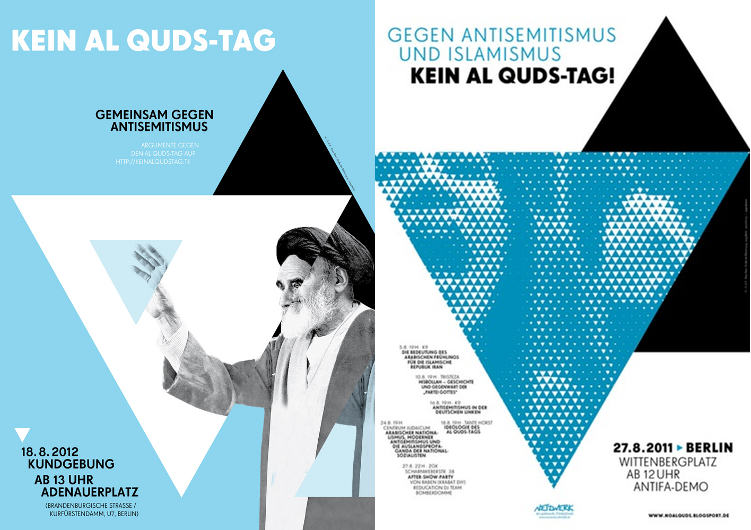
German flyers by an anti-Deutsch group protesting against the observance of “Al Quds Day”—first established by Khomeini in 1979 to express solidarity with the Palestinians.
Eliminatory anti-Zionism
The state of Iran is neither a dictatorship nor simply an authoritarian version of a capitalist society. For more than 30 years, the Islamic Republic has been ruled by a regime that exerts terror intensely at home and abroad, ideologically based on a religiously motivated claim to global power.[2] Considering the state of affairs, the regime tries to develop nuclear weapons[3] that threaten the existence of Israel and that could reach Europe. Labor unions are banned in Iran, and labor disputes and student protests have been brutally squashed alike. The systematic persecution of religious minorities like the Baha’i, the execution of homosexuals, and the omnipresent oppression of women who do not want to submit to the Islamist code of ethics, are part of the nature of this regime. The same is true for the continued threats of annihilation towards Israel and the denial or relativization of the Shoah.[4] What also distinguishes this regime from other Islamic despotisms is the combination of messianic and apocalyptic ideology, anti-Semitism, and the desire for the technology of mass destruction. Despite fundamental differences, the regime’s hatred towards communism, materialism, liberalism, Western plutocracy, Judaism, and Zionism, resembles German National Socialist ideology.
The Iranian dictatorship’s aim is to annihilate Israel. It exhibits no interest in actually improving the lives of Palestinians, a two-state solution, or any sort of compromise and balanced settlement of the Middle-Eastern conflict. This stance is neither new nor merely president Ahmadinejad’s individual point of view: Since 1979 the destruction of Israel has been part of the Islamic Republic’s official policy, and it is promoted by the fanatic supporters of Ahmadinejad, by conservatives, and also by those who are deemed by the West to be pragmatist or reformist mullahs and ayatollahs.
In Iran, it is not a state secret that the regime will never accept a Jewish state in the Middle East: The slogan “Death to Israel!” is a constituent part of the Islamist state propaganda since 1979 and is emblazoned on rockets capable of hitting Tel Aviv, regularly displayed at military parades. This claim was repeated incessantly in a May 2012 announcement by Fars News, a regime-controlled news agency with ties to the Revolutionary Guards. There Hassan Firouzabadi, the chief of staff of the Iranian army, proclaimed the aim of the Islamic Republic to be “the full annihilation of the Zionist regime of Israel,” while the supreme religious leader, Ali Khamenei, once again called the “Zionist regime” a “cancerous tumor that should be cut and will be cut.”[5] In August of this year, a few weeks after the EU had refused to list Hezbollah officially as a “terror organization,” Walid Sakariya—Hezbollah member of the Lebanese parliament and former general—declared of his Iranian allies’ nuclear program on the television station Al-Manar, “This nuclear weapon is meant…to finish off the Zionist enterprise.”[6]
Considering these statements, Wahied Wahdat-Hagh described the program of the Iranian regime as “eliminatory anti-Zionism.”[7] With that in mind, it is not at all surprising that anti-Zionist leftists pose as protectors of the Iranian regime and, worst of all, some Trotskyite groups even defend “Iran’s right to nuclear weapons”[8] while the international neo-Nazi scene cheers on the Iranian regime.[9]
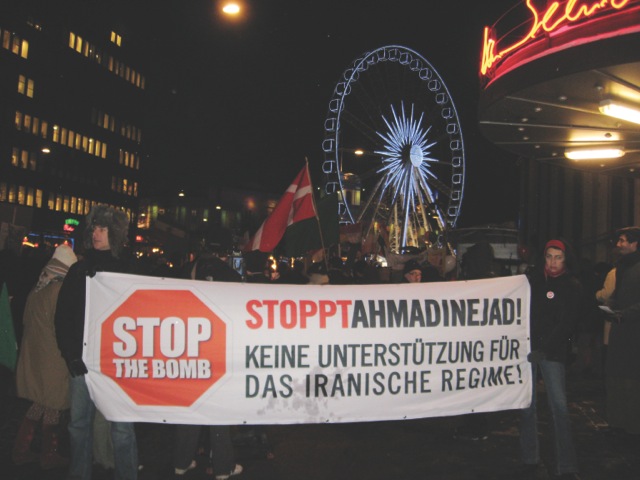
Demonstration against Ahmadinejad’s visit in Copenhagen, Denmark in December 2009. Keine Unterstützung für das iranische Regime translates to “No support for the Iranian regime.”
The rule of Islamist rackets
The Iranian regime’s aggressive foreign policy, which is characterized simultaneously by pragmatism and a mania for annihilation, corresponds domestically with a social form of organization that is characterized by the rule of competing gangs or “rackets.” Drawing from Max Horkheimer’s theory of a racket[10] and Franz Neumann’s study Behemoth, Gerhard Scheit analyzed the Islamic Republic as a “non-state.” According to his analysis, the Islamist revolution of 1979 represents “the opposite of the bourgeois revolution, which triumphed in France. Both revolutions lifted the state’s monopoly on the use of force and replaced it with the power of terrorist groups. However, in one case, the terror results in the rule of law that is guaranteed for the sake of capital’s realization by a new monopoly on violence. And in the other case, terror continues undiminishedly in the different forms of Sharia and sees itself shielded by the name of Allah and oil revenues.”[11]
Since Khomeini’s accession, the Iranian regime has been characterized by a rivalry of rackets hostile to each other while the supreme religious leader reigns above all and acts as a mediating authority. In this way, the whole Iranian constitution cannot be understood as a form of bourgeois law: “The complex structure of the constitution is merely there to provide room for the disparate activities of these rackets, who declaredly prefer the state of emergency.”[12] Since 1979, parallel to the state’s organs, additional institutions have been formed in Iran. The influence of the regular courts of justice is restricted through the existence of numerous special courts. Beyond those military tribunals that are common in other countries, there exist so called “Revolutionary Courts,” the “Court for the Justice of Bureaucracy,” the “Special Court for the Clergy,” and “Press Courts.”[13] Besides the national army, the Pasdaran has been established as an alternative revolutionary military force, which today is one of the most influential and probably the most dangerous racket within the regime’s power structure. The Revolutionary Guards not only represent the regime’s military elite unit, but also one of the most important economic conglomerates in Iran, which provides its members with economic and social gains. For several years now, the Pasdaran have used their military power to gain control of crucial branches of Iran’s economy, particularly in the realm of foreign trade.
Similar to German National Socialism, but in a different way, the Islamic “non-state” of Iran is capitalist and anti-capitalist at the same time: “Its position on ownership of the means of production is different in the respect that in the form of an industrialized mode of production this kind of ownership only exists to a minimal extent. Universal law and contract have disappeared here as well, replaced by the rackets’ arbitrary course of actions.”[14]
A central difference to National Socialism, however, is its position on labor. The affiliation with the Islamist collective, different from Nazi Germany, has almost nothing to do with labor as a commodity: “In such a collective, even somebody, who does not have any prospect for a job, can feel useful and not superfluous, even when he does not expect the umma to provide him with one. Everything beyond the racket system that threatens and exposes the individual to superfluousness, the individual projects on a total enemy, the Gegen-Volk (‘counter-nation’, ed.).”[15] These projections culminate in a suicidal desire for annihilation that concentrates on the State of Israel, that includes self-sacrifice, and that is virtually invoked by the Iranian Islamists’ ideology of martyrdom.
What is to be done?
How can a regime that carries on with the National Socialist’s ideological mania for annihilation, albeit under totally different conditions, be confronted? First, it should be remembered that with respect to Iran’s disregard of security council resolutions dealing with Iran’s uranium enrichment, even the UN Charter points out the possibility of “complete or partial interruption of economic relations and of rail, sea, air… and the severance of diplomatic relations.”
More severe and urgently necessary sanctions should not be understood as a contribution towards further negotiations with the regime and, in this way, should neither offer it a way out of its crisis, nor be misunderstood as a ploy to spur Ali Khomeini or the Pasdaran to undertake voluntary reforms. Instead, they must be designed as a decisive contribution to its weakening and to prospectively destroy the regime, which marks out an extended moment of regression in world history.
Of course, sanctions will to some degree always have a negative effect on the population of Iran. But firstly, nobody demands sanctions of food, medicine, and necessities. The focus lies on sanctions on the gas and oil exports as well as financial transactions, which represent the regime’s nerve center, and sanctions against the import of high-end technological products that are provided by companies of the German middle classes in particular. Secondly, the Iranian population has proven over the last few years that it does not blame the West for the sanctions, but rather blames the aggressive policy of the regime. Thirdly, everything that deprives the regime of financial means helps the Iranian opposition, since the regime’s aim is not the accumulation of capital, but to acquire financial resources for a political agenda that has already cost the lives of tens of thousands of Iranians and driven millions into exile. And finally: We should consider why sanctions are rejected by those leftists who zealously mobilize against any kind of military confrontation with the anti-Semitic Iranian regime.
Nobody can predict with certainty which decisions on sanctions will gain momentum during the coming weeks and how successful or unsuccessful the Iranian movement for freedom will be; however, such considerations should not to rule out the possibility of a military escalation. It is certain that Iran’s feverish nuclear program forces Israel to prepare for future confrontations. Within the solidarity movement for the Iranian freedom movement, this issue has been and is being far too much neglected—particularly by the Left and radical left-wing groups.
Many of those leftist organizations that have been chiefly involved in organizing solidarity events in exile after the faked elections of June 2009 were the ones who contributed to the mullahs’ accession to power in 1979. Many Marxist-Leninist and anti-imperialist Iranian leftists supported the Islamists above all because they erroneously, as Danny Postel emphasized in the forum hosted by the Platypus Affiliated Society on the Iranian left, understood “liberalism as part of a toxic, global, colonial project rather than viewing it, as Marx himself did, as being necessary but insufficient—or, better, insufficient but bloody necessary—to the project of socialism and liberation.”[16] The Iranian left, primarily the Marxist-Leninists, also supported Khomeini out of a shared hatred of Zionism and U.S. imperialism. To this day, not much has changed in that respect. In Germany and Austria left-wing demonstrators who march in solidarity with Israel were repeatedly expelled from rallies that support the Iranian freedom movement. Simultaneously, nobody there took offence when those Trotskyites who made common cause with the Iranian-backed Hezbollah at conferences in Beirut marched at the same rallies.
The radicalization of the freedom movement in Iran went hand in hand with a de-radicalization of some of its activists in exile. To prevent the radicalization of demonstrations they posed as stewards at rallies. Those who appeared as firm opponents of the regime and, for example, shouted “Down with the Islamic Republic” instead of “Down with Ahmadinejad” were expelled from demonstrations not only in Vienna and Berlin, but also in several cities in the U.S., especially during the first phase of protests in the summer of 2009.[17] The slogans of the Marxist-Leninist cadres and their reformist Islamist allies even fell back behind those demands that were voiced by protesters in Tehran at the risk of their lives. While the opposition movement’s slogan “Where is my vote?” was taken up on many solidarity rallies, people in Tehran were already chanting “Freedom, independence, Iranian Republic.” While in Europe great pains were taken not to confront the regime’s ideology offensively, Iranian protesters clearly renounced support for Hamas and Hezbollah as well as the Iranian nuclear program: “No to Gaza, no to Lebanon, I sacrifice my life for Iran” and “A green and blossoming Iran does not need nuclear arms,” ran the chants. And while reformist Islamists in the West warned that open declarations of support for the opposition in Iran by Europe and the U.S. would bring opponents of the regime into disrepute, the Iranians were already pondering out loud: “Obama! Obama! Either on our side or theirs!”[18]
The coalition “Stop the Bomb” was formed in Austria in late 2007 and Germany in 2008 in order to oppose domestic business deals with Iran and to challenge their political endorsement. Both countries have developed intense economic and political ties with the Iranian regime for the last 30 years. Established leftist groups, such as part of the antifascists, were greatly involved in setting up Stop the Bomb in both Germany and Austria. With an international petition and numerous other activities, Stop the Bomb targets supporters of the Iranian regime and received prominent support itself by nazi-hunter Beate Klarsfeld, the literary Nobel prize laureates Elfriede Jelinek and Imre Kertész, and Nobel peace prize laureate Elie Wiesel. Today, Stop the Bomb is active in Great Britain, the Netherlands and Spain as well, and it would be desirable to see similar organizations or initiatives arise in other countries, too—particularly with the help of the Left.
Despite their initial skepticism about the markedly Green Movement in Iran, Israeli diplomats have not only been trying to convince Europe, Russia, and China of the urgency of severe sanctions, but Israeli politicians, including the prime minister, have also repeatedly called on the West to support the Iranian freedom movement,[19] and members of the Iranian opposition have been received and welcomed by the Israeli president.[20] It should be clear that the fight for the freedom of the people in Iran is not separable from the fight against anti-Semitism and anti-Zionism.
There is a consensus in Israel that unilateral military strikes against Iranian nuclear facilities represent an extremely risky option.[21] Nevertheless, they are an option.
That the awareness of the Iranian threat and possible countermeasures is omnipresent in Israel’s society, a society which hardly ever arrives at general agreements like this one, is demonstrated by a left-leaning liberal and former party leader of Meretz, Yossi Beilin. He has shown to the public that, in this matter, a member of the so-called “peaceniks,” even in the choice of his words, does not differ from Likud’s prime minister Benjamin Netanyahu: “The military option represents the last resort, but they should not be taken off the table. Sanctions might be much more successful.”[22] Unfortunately, it is doubtful that U.S. foreign policy makers understand the gravity of the threat a nuclear-armed Iran poses, at least in the same way as the Israelis from nearly all camps do.
In the final analysis, the Israeli state can therefore only rely on itself, since Iran is only a strategic threat to the U.S., whereas it is an existential threat to Israel. The U.S. is rather willing to withdraw its support for the Iranian opposition in exchange for a murky agreement with the regime on its nuclear program.[23] Were the Iranian freedom movement to fail, were it unable to regroup the impulses of 2009’s mass demonstrations again, the lack of support by the states of the West as well as the international left will certainly be a reason for its failure. That would be an even more unwelcome development. The overthrow of the Iranian regime would definitely be the best solution. Yet as Michael Rubin, a notoriously hawkish neo-conservative, observes, rather than military strikes on the nuclear facilities, only a victory of the secular and democratic opposition that envisions a constitutional society can ensure that the threat of a nuclear Iran will be banished in the future.
The Left should fight on the front line against the regime in Iran. And if the West, as much criticism as it deserves, engages against this regime, the Left should not oppose that by simply following a myopic anti-imperialist reflex, but instead greet and support these actions—without deluding itself for a second about the character and the primary interests of the states of the West. An overthrow in Iran would not at all have a merely national or regional impact. One might hope that it would be a starting signal to stop the global advance of Islamic jihadism. And it would recall the rallying cry, which tens of thousands of Iranian women shouted for days as they demonstrated against the introduction of forced veiling in 1979, “Emancipation is not Western, emancipation is not Eastern, it’s universal!” |P
[1]. Theodor W. Adorno and Max Horkheimer, Towards a New Manifesto (London: Verso, 2010), 57.
[2]. See Ruhollah Khomeini’s Islamic Government (New York: Manor Books, 1979), available online at <http://www.al-islam.org/islamicgovernment/>, a collection of lectures held in 1970, which contains paragraphs that read like extracts of Adolf Hitler’s Mein Kampf (München: Eher Verlag, 1933).
[3]. See Yossi Melman and Meir Javedanfar, The Nuclear Sphinx of Tehran: Mahmoud Ahmadinejad and the State of Iran (New York: Carroll & Graff, 2007), and Emanuele Ottolenghi, Under a Mushroom Cloud: Europe, Iran and the Bomb (London: Profile Books, 2009).
[4]. The Holocaust denial conference in Tehran in December 2006, which gathered the international who’s who of Holocaust deniers, was inaugurated by Iran’s then foreign minister, Manouchehr Mottaki. See Wahied Wahdat-Hagh, “Iran: Islamist Holocaust Denial.” Available online at <http://antisemitism.org.il/article/71621/iran-islamist-holocaust-denial>.
[5]. “Top commander reiterates Iran’s commitment to full annihilation of Israel,” <http://english.farsnews.com/newstext.php?nn=9102112759>.
[6]. “Hizbullah MP General (ret.) Walid Sakariya: Iranian Nuclear Weapon to ‘Finish Off the Zionist Enterprise’.” <http://www.memri.org/clip/en/0/0/0/0/0/0/3525.htm>.
[7]. Wahied Wahdat-Hagh, “Die Herrschaft des politischen Islam im Iran. Ein Überblick zu Struktur und Ideologie der khomeinistischen Diktatur,” in Der Iran: Analyse einer islamischen Diktatur und ihrer europäischen Förderer, eds. Stephan Grigat and Simone Dinah Hartmann (Innsbruck: Studien Verlag, 2008), 44.
[8]. Michael Pröbsting, “Zu den Waffen! USA und Israel drohen mit neuen Krieg gegen den Iran,” available online at <http://www.arbeiterinnenstandpunkt.net/>. A more recent text demands “Military victory for Iran!” <http://www.rkob.net/international/nordafrika-und-der-arabische-raum/kein-angriff-auf-iran/>.
[9]. See Heribert Schiedel, “Heiliger Hass: Zur rechtsextrem-iranischen Freundschaft,” in Iran im Weltsystem: Bündnisses des Regimes und Perspektiven der Freiheitsbewegung, eds. Stephan Grigat and Simone Dinah Hartmann (Innsbruck: Studien Verlag, 2010), 165–173, and Stephan Grigat, “Mein Feind und Freund. Rechte Parteien in Europa entdecken das iranische Regime als Partner,” Die Zeit 14, available online at <http://www.zeit.de/2012/14/P-Rechte-Parteien-Islam>.
[10]. With his “sociology of rackets“ Horkheimer wanted to supplement his Sociology of Class Relations. In contrast to the theoretical model adequate to liberal bourgeois society, conspiring cliques of rackets characterized by unconditional allegiance and anarchic competition with each other became the central protagonists in the phase of monopoly capitalism. See Max Horkheimer, “Soziologie der Klassenverhältnisse,” in Gesammelte Schriften, Vol. 12 (Frankfurt am Main: Fischer Taschenbush Verlag, 2009), 104. See also Christoph Türcke and Gerhard Bolte, Einführung in die Kritische Theorie (Darmstadt: Wissenschaftliche Buchgesellschaft, 1994), 49.
[11]. All of the quotations in this passage have been translated into English from Gerhard Scheit’s essay “Der neue Vernichtungswahn und seine internationalen Voraussetzungen: Wodurch sich Ahmadinejads Islamische Republik von Hitlerdeutschland unterscheidet,” in Grigat and Hartmann, Der Iran, 58–78.
[12]. Scheit, “Der neue Vernichtungswahn,” 63.
[13]. See Wahied Wahdat-Hagh, Die Islamische Republik Iran. Die Herrschaft des politischen Islam als eine Spielart des Totalitarismus (Münster: Lit Verlag, 2003).
[14]. Scheit, “Der neue Vernichtungswahn,” 68.
[15]. Ibid., 70.
[16]. Available online at <http://platypus1917.org/2010/02/18/30-years-of-the-islamic-revolution-in-iran/>.
[17]. See Javad Asadian, Stephan Grigat, and Simone Dinah Hartmann, “Solidarität mit Israel gehört dazu,” Jungle World 32 <http://jungle-world.com/artikel/2009/32/36916.html>.
[18]. See Fathiyeh Naghibzadeh and Andreas Benl “Nachholehnde Säkularisierung: Bilanz und Perspektiven der iranischen Freiheitsbewegung,” in Iran im Weltsystem, eds. Grigat and Hartmann, 28, and Fathiyeh Naghibzadeh and Andreas Benl, “The Peace Train,” Jerusalem Post, April 16, 2012, available online at <http://www.jpost.com/Opinion/Op-EdContributors/Article.aspx?id=266297>.
[19]. See “Netanjahu rät zu Twitter-Propaganda,” Spiegel Online, December 7, 2009, available online at <http://www.spiegel.de/netzwelt/netzpolitik/konflikt-mit-iran-netanjahu-raet-zu-twitter-propaganda-a-665649.html>.
[20]. See “Fiancé of Slain Iranian Protester Neda Soltan Meets Peres,” The Jerusalem Post, March 23, 2010, available online at <http://www.jpost.com/Israel/Article.aspx?id=171614>.
[21]. Understandably, the discussion on possible military strikes against the Iranian nuclear program has been a part of Israeli daily politics for months now, and nobody, including the supporters of military action, takes that debate lightly. On the dissensions between the Israeli leadership and the U.S. administration about this issue see Stephan Grigat, “20 Jahre Friedesprozess gegen Israel: Von Oslo zur iranischen Bombe,” Sans Phrase. Zeitschrift für Ideologiekritik, 1 (2012), available online at <http://www.sansphrase.org/>.
[22]. “Indirekte Nahostgespräche sind idiotisch,” Der Standard, February 17, 2010, available online at <http://derstandard.at/1266279099007/Indirekte-Nahostgespraeche-sind-idiotisch>.
[23]. Since 2000, when the legitimacy of the “Islamic Republic” was being questioned by the Iranian population, numerous U.S. officials have spoken about the necessity of “mutual respect” and the regime’s “legitimate interests”: if only Iran would keep its hands off a nuclear program. Inevitably this kind of talk is detrimental to Iran’s opposition. On the misguided U.S. policy of the past 30 years towards the Iranian regime see Hassan Daioleslam, “Der gezähmte ‘Große Satan:’ US-amerikanische Iran-Politik und der Lobbyismus des Regimes,” in Iran im Weltsystem, eds. Grigat and Hartmann, 105–113.