


An Unmet Challenge: Race and the Left in America
Ben Blumberg
Platypus Review 19 | January 2010
IN HIS 1932 NOVEL BANJO, the radical black intellectual Claude McKay portrays the vibrancy of black cosmopolitanism in the French port city of Marseilles in the decade following the end of World War I. McKay’s characters—boys of the docks, mendicants, and drifters—grapple with the racism of the wider society, while in their relations to one another live beyond race’s narrowness. One in particular, the novel’s protagonist, an itinerant intellectual named Ray, is driven by French police brutality to reflect on the reality of his race. In a powerful passage, McKay describes Ray as refusing “to accept the idea of the Negro simply, as a ‘problem.’ All of life was a problem….To Ray the Negro was one significant and challenging aspect of the human life of the world as a whole….If the Negro had to be defined, there was every reason to define him as a challenge rather than a ‘problem’ to Western civilization.”[1] To this day, Ray’s challenge remains unmet, not only in France, but in the United States and the rest of the world.
Following Ray, the term “challenge” is used here to signify a refusal of the traditional labeling of anti-black racism and racially justified segregation as a “problem.” Naming racism and segregation as a problem merely acknowledges and passively describes a fact. However, the challenge is to elevate the problem’s mere existence to the level of reality, to shape it through thought and action into a material that, because consciously formed, can be transformed and overcome.
For the American Left in the first half the 20th century—commonly referred to as the “Old Left”— the task of advancing freedom entailed a thoroughgoing critique of the racist institutions in American society, a socioeconomic and historical analysis of their origins and contemporary function, as well as practical efforts to eradicate these structures. In other words, racism was the challenge faced by the American Old Left. However, to a large extent it evaded the very challenge it set for itself by accepting the characterization of the black population’s political situation as “the Negro problem.” Only the best of the Old Left pushed against this characterization. The New Left, seeking to overcome the Old Left’s shortcomings and receiving a great impulse from the demands of the Civil Rights movement to do so, would nevertheless come to reenact the previous generation’s failings. This brings forth an uncomfortable question: if Marxists in the United States were unable to meet the challenge of raising racism to the level of a transformable reality, then to what extent can we speak of an American tradition of Marxism—a Marxism adequate to the situation of American capitalism—at all?
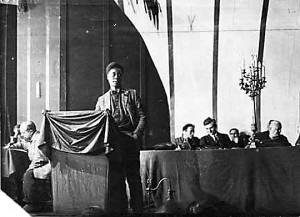
Claude McKay addressing the Fourth Congress of the Communist International in Moscow in 1922.
Marxism was at first a transplant to the United States, brought with the arrival of radicals who were compelled to leave Europe after the failed revolutions of 1848. However, as an organized political movement, it was forged with the great inspiration and impetus given by the Bolshevik revolution in Russia in 1917, and the subsequent revolutions that swept through Europe and the world. These profoundly radicalizing events led to the formation of the Communist Party of the United States of America (CP), first in 1919 as two separate and competing tendencies, and then as a unified Workers Party in 1921. According to James P. Cannon, one of the Communist Party’s leaders in the 1920s, and one of the leaders of the Trotskyist fight against Stalinism from 1928 onward, the first years of the Communist Party were dominated by foreign émigrés with direct experience in Europe’s mass Marxist parties. Their experience within Marxism led them to believe that it was their duty to preserve the integrity of Marxism against any misinterpretations by its new, less experienced American practitioners. However, this inadvertently led to a neglect of specific aspects of the historical development of the United States, most crucially the struggle against slavery, segregation, and racism. This theoretical deficiency remained even after the growth enjoyed by the CP in the 1920s and 1930s.
Thus limited by its theoretical outlook, the American Communist Party neglected the critical question: How should Marxists account for the specificity of national historical development, while, at the same time, attempting to overcome the nation-state as a political framework? In the case of anti-black racism and segregation, this requires us to critically reevaluate the dialectic of separatism and integration/assimilation in the race politics of the United States.
Concurrent with the formation of the Communist Party in the United States was a reactionary intensification of segregation, the roots of which extended back to the defeat of the period of Reconstruction following the Civil War. As a result of that defeat in the 1870s, many black ex-slaves fled the penury of the sharecropper system in the South to enter into northern industrial production. This process accelerated with the increased need for industrial labor generated by World War I. During this period the racist attitudes of the white working class were inextricably bound up with the assault on the liberties, freedoms, and personal safety of black Americans. So, while there were certainly many important examples of racial solidarity among members of the working class at the time—such as the black and white working class’s defense of the black population during the Chicago race riots of 1919—still, in the eyes of many of its black counterparts and their leadership anti-black racism characterized America’s white working class. The exclusionist practices of the American Federation of Labor (AFL) were a particularly egregious example of this in the labor movement itself. The AFL claimed at the time of its founding in 1886 to follow in the tradition of the Knights of Labor, and to practice the principle of labor solidarity without racial prejudice. However, this soon became a dead letter, as many of the affiliated craft unions refused to include black workers. Historian Theodore Draper has emphasized the equivocations made by the organization when confronted by this problem, describing how “[a]s early as 1900 the AFL’s leaders resorted to the futile and tainted device of issuing its own charters to separate Negro locals. As a result, the AFL for half a century largely evaded the problem of, or blocked the way to, organizing Negroes.”[2] The concessions made to Jim Crow in order to placate racist workers and advance labor’s short-term goals combined with the paranoia of white workers who feared having their position undercut by cheap black labor to produce extremely difficult obstacles for the communist movement to overcome.
It was in this context of Reconstruction’s failure and the racialized division of the working class that the Jamaican black separatist Marcus Garvey first gained for himself and for his United Negro Improvement Association (UNIA) a mass following in the United States under the slogans “Africa for the Africans” and “Back to Africa.” Garvey’s movement was both courted and contested by the Communists in the immediate post-war years.[3]
While the large following Garvey had garnered could not be ignored, the communists resisted interpreting it as an actual longing for African repatriation, viewing Garvey’s slogans as quixotic and unlikely to garner appeal among black Americans.[4] Communists in the early 1920s concluded that the militant stance that Garvey took toward white domination expressed black Americans’ frustration with the slow pace of social integration and their anger at the betrayal of the democratic ideals for which many black soldiers thought they had fought in World War I. Garvey’s black nationalism had little theoretical impact on the communists until later in the decade, when Stalin tightened his grip over the Third International. Indeed, it is ironic that the Communist Party only truly began to absorb Garvey’s influence in 1928, after the collapse of the UNIA due to Garvey’s personal failings and outright fraudulence. Yet, the Stalinist ideal of “socialism in one country” retrospectively justified Garveyist ideas, and so the Back to Africa movement enjoyed posthumous influence in the form of the Communist Party’s “Black Belt thesis.”
The Black Belt formula, first developed in 1928 and instated as official policy in 1930, held that the black population in a portion of the United States constituted a nation within a nation. James S. Allen, who by the early thirties had become one of the Party’s authorities on this matter, defined the “Black Belt” as a territory stretching from east of Dallas, Texas to just south of Washington D.C., encompassing portions of twelve southern states. According to Allen, this crescent contained a string of contiguous counties inhabited predominately by segregated black sharecroppers working on cotton plantations under conditions not dissimilar from the chattel slavery that had defined the region prior to the Civil War. Shaped by the history of slavery, and hardened by decades of segregation, this “black nation” represented to the Communist Party the North American equivalent of an oppressed colony.[5] Construing the problem in this way, Communists were compelled to advocate for the Black Belt’s “national self-determination.” For black Americans living outside of the south the Party retained the slogan, “full social, political and economic equality.” Thus, the Black Belt thesis was elaborated within the Party during the same years that Stalin’s theory of “socialism in one country” naturalized the nation-state as the “organic” boundary for revolutionary politics.[6] In sundering the part (the south) from the whole (the United States and global capitalism), the American Communist Party’s call for black self-determination contributed to the global defeat of Marxist internationalism and, with it, the dissolution of the spirit of radical cosmopolitanism articulated by intellectuals like McKay. The national frame ceased to be the immediate context of American politics and became its absolute horizon and insurmountable limit.
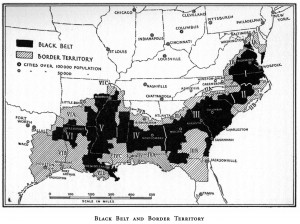
Map included in James S. Allen’s 1936 The Negro Question in the United States.
The American Communist Party’s theoretical failings regarding race and racism were extreme and had profoundly destructive effects not only on the struggle against anti-black racism and segregation but also on the entire international struggle for human emancipation through the revolutionary overcoming of capitalism. But, to speak only of the immediate consequences, there were two: First, the Communist Party smuggled into Marxism a disguised apology for the existence of racial segregation by misunderstanding the separation of the races as being derived from and expressive of national difference. The overcoming of racism had been a matter of revolution per se. Now, it was reformulated as a national question distinct from and thus free of considerations of international proletarian revolution. Second, the Communist Party neglected to recognize that Garvey’s separatism saw the oppression of black people worldwide as part of a unified reality, and thus contained within itself at least a germ of internationalism, however distorted by the ideology of racial separatism. This potential internationalism within black separatism was precisely what was at stake for McKay in his portrayal of the black cosmopolitanism burgeoning in the Marseilles of the 1920s, a result of the black participation in the World War I and the increased incorporation of black workers into world industry.
It would be easy, given the now commonplace critique of Stalinism, to simply attribute the theoretical problems of the Communist Party in the United States to the political direction determined for it by the Stalinist Comintern. However, when we look to the history of the opposition to Stalinism—the Left Opposition, and, later, the Fourth International—we find no tradition worthy of unqualified endorsement. Instead, there is the history of a more adequate perspective being eschewed in favor of rearticulations, in various forms, of the Communist Party’s basic misconceptions. Not until 1933 did there emerge a potentially more adequate perspective with the composition of a pamphlet by Max Shachtman entitled Communism and the Negro and the discussions in Turkey between Arne Swabeck and Trotsky.[7] Unfortunately, the insights of these perspectives were neglected, as well.
Shachtman’s pamphlet was never published by the Communist League of America (CLA), and although it was clearly intended as a contribution to the thoroughgoing study called for by the CLA’s 1931 National Conference, it is unclear how widely it was circulated.[8] From Shachtman’s letters it is certain that the pamphlet’s immediate purpose was to persuade Trotsky to his point of view. However, it appears Trotsky never gave it due attention. This was unfortunate, since Shachtman’s argument represented a major theoretical advance in the Marxist understanding of the challenges of race and racism. It emphasized that black ex-slaves played a crucial role in restructuring southern society after what Shachtman called “the Second American Revolution,” i.e. the destruction of slavery that accompanied the Union’s victory in the Civil War. Shachtman further pointed out that their defeat by the counterrevolutionary, racist denouement of Reconstruction established the fundamental challenge faced by the Marxists of his day: a conservative, chauvinistic, and racist working class. Shachtman argued that the possibility of integrating the United States required an awakening of the revolutionary class consciousness of the American proletariat and that this in turn required the proletariat to realize that, in order to liberate itself, it must, as Marx and Engels said in The Holy Family, destroy the conditions for its own existence. In the specific context of the United States this meant, inter alia, destroying the working class’s racial segregation and the racist consciousness that accompanied it.
A large section of Shachtman’s pamphlet was devoted to exposing the fallacies of James S. Allen’s conclusions about the nature of the South and its agrarian black population. Allen’s work attempted to justify on sociological grounds the national self-determination slogan. Through the interpretation of census data, Allen claimed that the southern black population, which comprised the majority of the American black population at the time, would permanently adhere to the region.[9] Implicit in this analysis was a conservative reading of the historical conditions faced by the American black population, one that assumed the experience of slavery and segregation was so indelible as to permanently entrench the separation of the races. Thus, to Allen, southern blacks were not only likely to remain an unintegrated part of American economic and social life, but their exclusion had produced a nascent national identity separate from that of the “white” American nation. Today’s world has clearly demonstrated the incorrectness of these views. Even by the 1960s Draper could write,
If the Communists made any progress among Negroes in the 1930, it was due to their militant championing of “equal rights,” not “self-determination.” One reason for the failure of self-determination was that it went against the tide of history….In effect, the Black Belt has been getting smaller and less black for half a century, gradually cutting the ground from under the thesis of its “self-determination.”[10]
Decades before the “tide of history” was readily apparent, Shachtman was able to expose just how dubious was Allen’s reasoning. Although Shachtman painstakingly mobilized sociological data to undermine Allen’s argument, the strength of his analysis lay in his recognition of the force inherent in the unfulfilled possibilities of the Civil War and Reconstruction, on the one hand, and industrial integration, on the other. Allen’s myopia, by contrast, resulted from his one-sided emphasis on the brutality of slavery and segregation. Even if Shachtman’s pamphlet had no other merit than this, it would represent an important contribution to the Left’s capacity to meet the challenge of race and racism.
Shachtman’s pamphlet unfortunately had much less effect on the trajectory of the CLA, the American section of the Left Opposition, than did the results of the 1933 discussions in Turkey between Trotsky and Arne Swabeck. In these talks, Swabeck emphasized the same revolutionary potential of the demand for integration that Shachtman emphasized in his pamphlet, but Trotsky remained unconvinced. It is important to note, however, the lack of conviction that characterized Trotsky’s perspective, as he himself admitted to being unfamiliar with the circumstances. Still, Trotsky considered the demand for equality as essentially liberal, whereas, extrapolating from his experiences in the Russian Revolution, he thought the demand for self-determination and, by extension, the politics of black separatism might have considerable revolutionary potential. From 1933 onward, then, the CLA’s perspective was muddled. The stagnation and then regression of a Leftist theory of race is made painfully clear by the 1939 conversation in Mexico between Trotsky and West Indian Marxist C. L. R. James. The product of this conversation was a resolution on the “Negro Question” which mirrored the very shortcomings in the Communist Party’s program that the CLA (now renamed The Socialist Workers Party (SWP)) had previously criticized.
Taking Trotsky’s tentative conclusions in his conversation with Swabeck and his later dialog with James as a dictum, the Fourth International, in a 1939–1940 resolution, came out in favor of black national self determination, “should they want it.” But this missed Trotsky’s most important point: the correct perspective towards the struggles against racism and segregation could only be developed in the course of attempting to practically intervene in the reality of the problem. This would have meant an attempt to build a black Trotskyist leadership and to wage war against the chauvinistic racist attitudes of the American proletariat both white and black, but especially white. But instead of this, the Trotskyists left the issue still unresolved, adopting the view that “we must wait and see.” In a politically impoverished situation, the Trotskyists, like the Communist Party, left black workers to fend for themselves. The black proletariat was expected to raise itself to the task of “determining themselves,” to pull their politics up by their bootstraps. During this time, the black recruits to the Trotskyist SWP almost entirely abandoned it.
The next phase of the attempt to recognize the challenge posed to Marxism by racism and segregation began in the context of the full-scale liquidation of the revolutionary content of Marxism by the SWP, characterized by a continued acceptance of the notion of Black Nationalism. By the 1950s Trotskyism was wrecked by the loss of an internationalist perspective—a loss represented by “Pabloism” and an anti-theoretical mentality that maintained that revolutionary theory had only to be completed by practical implementation. Opposition to this development began to form within the SWP, led in part by Richard Fraser. Fraser argued against the party’s line on black nationalism, returning to the arguments of Shachtman and Swabeck. Advancing a theory of revolutionary integrationism, he argued that black workers were destined to take up a vanguard role in the revolutionary struggle.
Writing in the 1950s, Fraser stressed the importance of consciousness and theory as necessary elements of the struggle to overcome capitalism and, more particularly, the racist form it had taken in the United States.[11] However, Fraser’s perspective was limited by two factors. First, in his understanding of revolution and integration he tacitly accepted the national frame. Second, despite his emphasis on the critical role of consciousness in the fight against racism and segregation, he nevertheless argued that, simply because blacks faced extraordinary repression from the racist U.S. state, the black worker could be expected, by virtue of this super-exploitation, to develop a consciousness of their situation. By this retreat into a liberal conception of interest-driven politics, Fraser repeated the anti-theoretical attitude of his opponents within the SWP and thus missed the opportunity to critically grasp race dynamics in American capitalism.
Reducing in theory the dialectic of separatism and integration to a national question, the Communist Party’s positions on race, and in particular its support of black nationalism, had ramifications beyond its immediate moment. Indeed, it was just this Stalinist legacy that resulted in the revolutionary posturing of the New Left as it came up against the limits of the Civil Rights movement. But the challenge of adequately understanding race and racism did not disappear simply because a politics adequate to it was given up. Instead, as Draper puts it, the ideological issues posed by black nationalism were “rediscovered” by the New Left in the 1960s. Because this younger generation of social thinkers failed to address the theoretical failures of the Old Left, they ultimately ended up reproducing the same ideological shortcomings. What the New Left found was an attenuated form of ideology relevant—albeit in problematic ways—to historical, sociopolitical, economic, and cultural conditions that had since undergone significant change. This was recognized at the onset of the “Black Power turn” in the late 1960s by Harold Cruse, whose Crisis of the Negro Intellectual represents perhaps the most profound reflection on the intergenerational connections between the Old and New Left’s understanding of the challenge of race and racism. In the chapter entitled “Postscript on Black Power,” Cruse wrote, “When the direct-action methods [of the Civil Rights movement] failed against hardening barriers, they had to fall back on…the slogan of Black Power, as if to convince themselves that they were taking a revolutionary step forward….Whatever it is, it is essentially another variation of the Old Communist leftwing doctrine of ‘self-determination in the black belt areas of Negro majority.’”[12]
If we take Cruse’s insight seriously then we cannot escape the fact that the history of the challenge posed by anti-black racism and the errors of Marxists in attempting to overcome it have left a bitter legacy for the Left. If today’s Left hopes to digest this history then it is incumbent upon us to consider how and why the communist Left did not raise an adequate opposition to race and racism. Such historical analysis could help illuminate why, despite the important progress made in the struggle against the racial structuring of American society, an adequate theory of the correlation between poverty and race and racism in advanced capitalist societies is still lacking. While the solution is unlikely to be identical to what was proposed 80 years ago, we must nevertheless reflect on how the political mistakes of the Stalinist Communist Party, and the Left Opposition’s abandonment of its critique, has left the class-consciousness of the American working class, situated at the heart of global capitalism in the postwar period, deformed by racism. We live with the consequences today. |P
[1]. Claude McKay, Banjo (Orlando: Harper & Brothers, 1957), 273.
[2]. Theodore Draper, American Communism and Soviet Russia: The Formative Period (New York: The Viking Press, 1960), 316.
[3]. See Mark Solomon, The Cry Was Unity: Communists and African Americans, 1917-36 (Jackson: University Press of Mississippi, 1998), 22–29.
[4]. For example, see John Reed’s argument in his speech at the Second Congress of the Communist International: “The Negros do not pose the demand of national independence…. They hold themselves above all to be Americans, they feel at home in the United States.” John Reed, “America and the Negro Question,” The Minutes of Second Congress of the Communist international, Fourth Session, 25 July 1920.
[5]. James S. Allen, The Negro Question in the United States (New York: International Publishers, 1936), 13–24.
[6]. Stalin himself may have overtly intervened in the matter, personally seeing to it that black national self-determination became the orthodox communist position regarding race in America. According to Theodore Draper, a delegation of black American communists visiting the Comintern in 1925 were told by Stalin that black Americans were a “national minority with some of the characteristics of a nation.” The delegation’s reaction, that this sounded like “Jim Crow in a revolutionary guise,” was ignored. See Draper, American Communism, 334.
[7]. Max Shachtman, Race and Revolution (New York: Verso Press, 2003).
[8]. Writing from Büyükada, Turkey, Shachtman complained to Martin Abern that he had been unable to discuss the CLA’s program for black Americans with Trotsky. He then indicated that he felt his pamphlet was being ignored, writing, “By the way, has my pamphlet completely disappeared? Is it never to see light?” [Max Shachtman to Martin Abern, 22 June 1933, Box 2, Folder 48B, Max Shachtman Papers (TAM 103), The Tamiment Library & Robert F. Wagner Labor Archives at New York University].
[9]. Allen, Negro Question, 24–31.
[10]. Theodore Draper, The Rediscovery of Black Nationalism (New York: The Viking Press, 1970), 65.
[11]. See Richard Fraser, “The Negro Struggle and the Proletarian Revolution”.
[12]. Harold Cruse, Crisis of the Negro Intellectual: A Historical Analysis of the Failure of Black Leadership (New York: New York Review of Books, 2005), 547.